
The execution of Antonescu and his associates at Jilava
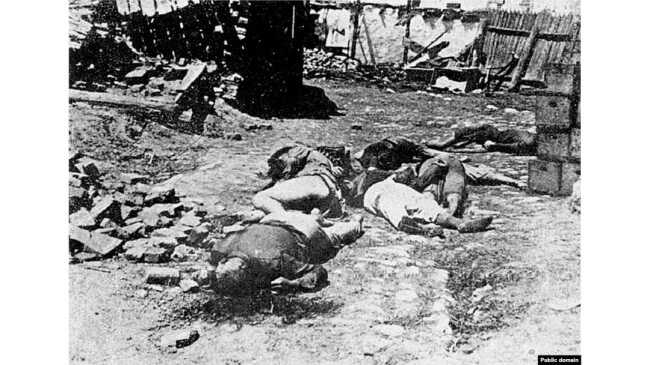
In 1922 the 40-year-old Ion Antonescu, a promising officer who had attracted attention during the First World War, was appointed military attaché at the Romanian embassy in France. One of the French diplomats who regularly dealt with him gave him this characterization: “He has a flexible mind, is two-faced, very vain, possesses an enormous will to succeed, and is an extreme xenophobe… Such are the main traits of this strange figure.” According to the recollections of people who knew him, Antonescu was distinguished by a choleric temperament and mood swings.
Strange or not, Ion Antonescu pursued a successful military career, rapidly rose to the rank of general and, in 1933, to the post of Chief of the General Staff of the Romanian Army. That same year Hitler came to power in Germany. Characteristically, his future devoted ally at that time felt no great sympathy for the Third Reich. Antonescu had nothing against strengthening Romania’s ties with Great Britain and especially with France (the Romanian elite was traditionally Francophile), and he regarded Hungary as his country’s main enemy, the two states being divided by a territorial dispute over Northern Transylvania. In the 1930s the general also increased his political weight, although his relations with the then head of state, King Carol II, did not go well. He did, however, establish contacts with a number of radical nationalist politicians—for example the poet Octavian Goga, who was briefly appointed prime minister in 1938.
Less cordial were his relations with the leader of the fascist Iron Guard (also known as the Legion of the Archangel Michael), Corneliu Zelea Codreanu. Even so, when Codreanu, who was at odds with the king, was charged with treason and stood trial, Antonescu publicly shook his hand. As a result he himself became an enemy of the royal government, which, despite its nationalist policies, he considered corrupt and sold out to the Jews (the future Conducător had been a convinced antisemite from his youth). This led to Antonescu’s removal from all posts, a brief period of house arrest—and growing popularity in the rising far-right circles.
In 1940 the Soviet Union demanded that Bucharest cede Bessarabia, which had belonged to Romania since 1918, and Northern Bukovina. Germany, on whose help the Romanian government was counting, in collusion with the Soviet Union “friendly advised” Carol II to satisfy these demands. Soon Hungary and Bulgaria, backed by Berlin, also put forward territorial claims against Romania. The Germans demanded that Ion Antonescu be appointed prime minister. This took place on 5 September 1940; the next day Carol II was forced to abdicate in favour of his young son Michael and flee the country, and Antonescu became the de facto ruler of Romania.
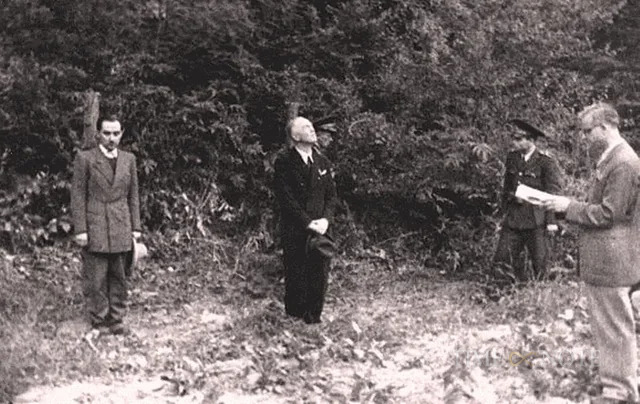
On 1 June 1946, at Jilava prison near Bucharest, Romania, the official execution of a death sentence handed down by the People’s Tribunal took place—four of Romania’s highest former state leaders and representatives of the regime were shot. Both the transfer to the place of execution and the shooting itself were filmed, thus recording both the course of the event and its participants.
Those shot were Ion Antonescu (former head of state, or Conducător), Mihai Antonescu (former foreign minister), Constantin Z. Vasiliu (former interior minister / commander of the Gendarmerie) and Gheorghe Alexianu (former governor of Transnistria). In the titles of the filmed chronicle they are named as the condemned. The other persons mentioned in the titles were official attendees: Colonel Dumitru Pristavu (commander of Jilava Military Prison), Teodor/Octavian Totolici (prison chaplain), Gheorghe Colac (clerk/grefier of the People’s Tribunal*), Alexandru Grigore Ionescu (forensic doctor), Constantin Paraschivescu-Bălăceanu (lawyer).
The prosecutors who supervised the execution were Alfred Petrescu and Gheorghe Săndulescu; the firing squad was commanded by Vasile Frugină with about 30 policemen/guards. The film footage shows four men in suits falling after the volley, after which military personnel walk among them and fire coup-de-grâce shots.
*) Grefier (Romanian grefier) is a court registry official: a person who keeps the minutes of hearings, prepares and signs official documents, manages case files and assists the judge administratively. In the Romanian judicial system (influenced by the French civil-law tradition) this post is distinct and officially bears that name. Gheorghe Colac in the video was the grefier of the People’s Tribunal, that is, the person who recorded the proceedings and was present at the execution as an official.
Map
Sources: timenote.info
Persons
| Name | ||
|---|---|---|
| 1 |  | Ion Antonescu |