
Daniel Kahneman

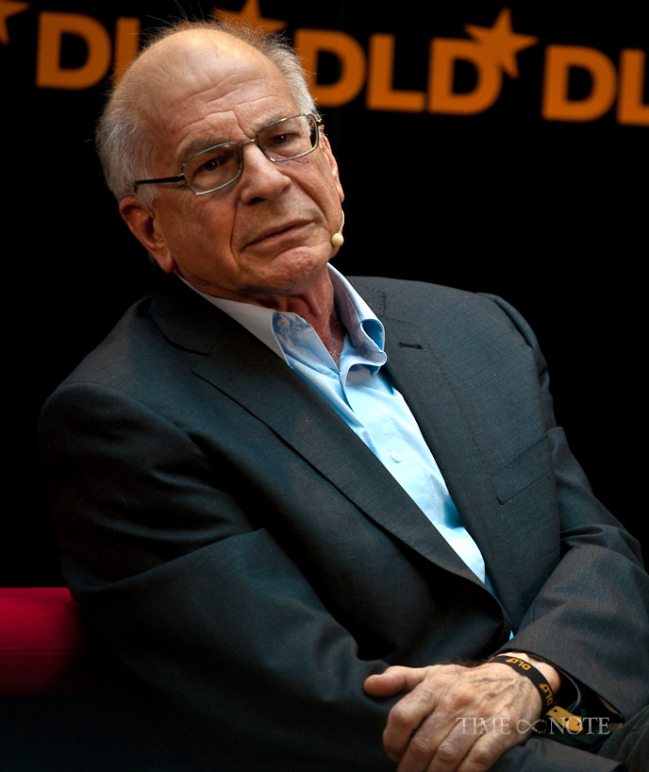
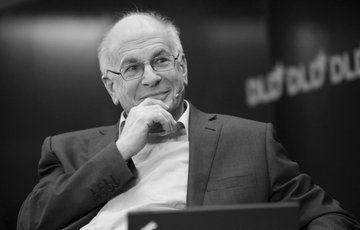
- Birth Date:
- 05.03.1934
- Death date:
- 27.03.2024
- Person's maiden name:
- דניאל כהנמן
- Extra names:
- Даниэль Канеман
- Categories:
- Academician, Nobel prize, Psychologist, Scientist
- Cemetery:
- Set cemetery
Daniel Kahneman (/ˈkɑːnəmən/; Hebrew: דניאל כהנמן; March 5, 1934 – March 27, 2024) was an Israeli-American psychologist best known for his work on the psychology of judgment and decision-making as well as behavioral economics, for which he was awarded the 2002 Nobel Memorial Prize in Economic Sciences together with Vernon L. Smith. Kahneman's published empirical findings challenge the assumption of human rationality prevailing in modern economic theory. Kahneman became known as the "grandfather of behavioral economics."
With Amos Tversky and others, Kahneman established a cognitive basis for common human errors that arise from heuristics and biases, and developed prospect theory. In 2011, Kahneman was named by Foreign Policy magazine in its list of top global thinkers. In the same year, his book Thinking, Fast and Slow, which summarizes much of his research, was published and became a best seller. In 2015, The Economist listed him as the seventh most influential economist in the world.
Kahneman was professor emeritus of psychology and public affairs at Princeton University's Princeton School of Public and International Affairs. Kahneman was a founding partner of TGG Group, a business and philanthropy consulting company. He was married to cognitive psychologist and Royal Society Fellow Anne Treisman, who died in 2018.
Early life
Daniel Kahneman was born in Tel Aviv, in the British Mandate of Palestine (now Israel), on March 5, 1934 while his mother Rachel (née Shenzon) was visiting her family. His parents were Lithuanian Jews who had emigrated to France in the early 1920s; his paternal uncle was Rabbi Yosef Shlomo Kahaneman, the head of the Ponevezh Yeshiva. He spent his childhood years in Paris. Kahneman and his family were in Paris when it was occupied by Nazi Germany in 1940. His father, Efrayim, was picked up in the first major round-up of French Jews, but he was released after six weeks due to the intervention of his employer, La Cagoule backer Eugène Schueller. The family was on the run for the remainder of the war but survived except for Efrayim who died of diabetes in 1944. Kahneman and his family then moved to Mandatory Palestine in 1948, just before the creation of the state of Israel.
Kahneman wrote of his experience in Nazi-occupied France, explaining in part why he entered the field of psychology:
It must have been late 1941 or early 1942. Jews were required to wear the Star of David and to obey a 6 p.m. curfew. I had gone to play with a Christian friend and had stayed too late. I turned my brown sweater inside out to walk the few blocks home. As I was walking down an empty street, I saw a German soldier approaching. He was wearing the black uniform that I had been told to fear more than others – the one worn by specially recruited SS soldiers. As I came closer to him, trying to walk fast, I noticed that he was looking at me intently. Then he beckoned me over, picked me up, and hugged me. I was terrified that he would notice the star inside my sweater. He was speaking to me with great emotion, in German. When he put me down, he opened his wallet, showed me a picture of a boy, and gave me some money. I went home more certain than ever that my mother was right: people were endlessly complicated and interesting.
— Nobel Prize Bio 2002
Education and early career
In 1954, Kahneman received his Bachelor of Science degree, with a major in psychology and a minor in mathematics, from the Hebrew University of Jerusalem. Israeli intellectual Yeshayahu Leibowitz, whom Kahneman describes as influential in his intellectual development, was Kahneman's chemistry teacher at Beit-Hakerem High School, and Kahneman's physiology professor at university. Kahneman was average in mathematics, but he thrived in psychology. Kahneman was led to psychology when he discovered in his teens that he was more interested in why people believe in God than in whether God exists, and more interested in indignation than in ethics.
In 1954, he began his military service in the Israel Defense Forces as a second lieutenant, serving for a year in infantry. He then served in the psychology department of the IDF. He developed a structured interview for combat recruits, which remained in use in the IDF for several decades.
In 1958, he went to the United States to study for his PhD in Psychology at the University of California, Berkeley. His 1961 dissertation, advised by Susan Ervin, examined relations between adjectives in the semantic differential and allowed him to "engage in two of [his] favorite pursuits: the analysis of complex correlational structures and FORTRAN programming".
Partnership with Amos Tversky
Kahneman and Amos Tversky's collaboration helped launch the field of behavioral economics.
Kahneman and Tversky first crossed paths in the psychology department at the Hebrew University of Jerusalem in 1968. In the period between 1971 and 1979 they published work on judgment and decision-making that led to Kahneman winning the Nobel Prize. During this period they were described as "inseparable" and as "soul mates".
After leaving Israel in 1978 and accepting positions at different universities, the intensity and exclusivity of their earlier period of joint collaboration was reduced. According to Kahneman the collaboration "tapered off" in the early 1980s, although they tried to revive it, but the period when Kahneman published almost exclusively with Tversky ended in 1983, when he published two papers with Anne Treisman, his wife since 1978. Factors contributing to this estrangement included Tversky receiving most of the external credit for the output of the partnership, and a reduction in the generosity with which Tversky and Kahneman interacted with each other, leading Kahneman to say, "I eventually divorced him". However, they would continue to publish together until the end of Tversky's life, and worked together on the introduction to an edited collection of papers related to their work during the last six month's of Tversky's life.
Personal life
Kahneman married his first wife, Irah Kahn, when they were students; they had two children. The couple later divorced. Their daughter Lenore, who works in pharmaceuticals, assisted her father on his Nobel lecture. His son Michael, has schizophrenia. Kahneman was quoted as saying that Michael "would have been a very brilliant economist."
From 1978 until her death in 2018, Kahneman was married to the cognitive psychologist Anne Treisman. They lived part-time in Berkeley, California. From 2020, Kahneman lived in New York City with Barbara Tversky, also a cognitive psychologist, and the widow of his long-time collaborator Amos Tversky.
Kahneman described himself as a very hard worker, "a worrier" and "not a jolly person", and said that he was "quite capable of great enjoyment, and I've had a great life". Richard Thaler called his close friend an "avid pessimist." Thaler, a self-described optimist, said Kahneman claimed that worrying was rational, "because he would not be disappointed as much with the outcomes of life."
Death
Kahneman died on March 27, 2024, three weeks after his 90th birthday. Given his personal experience with dementia, from which his wife Anne Treisman had suffered, Kahneman received assistance in dying from the Swiss organization Pegasos, and died in the municipality of Nunningen, Switzerland. The manner and location of his death were only revealed in March 2025.
Source: wikipedia.org, timenote.info
No places

| Relation name | Relation type | Description | ||
|---|---|---|---|---|
| 1 |  | Sigmund Freud | Idea mate | |
| 2 |  | Carl Gustav Jung | Idea mate |
No events set