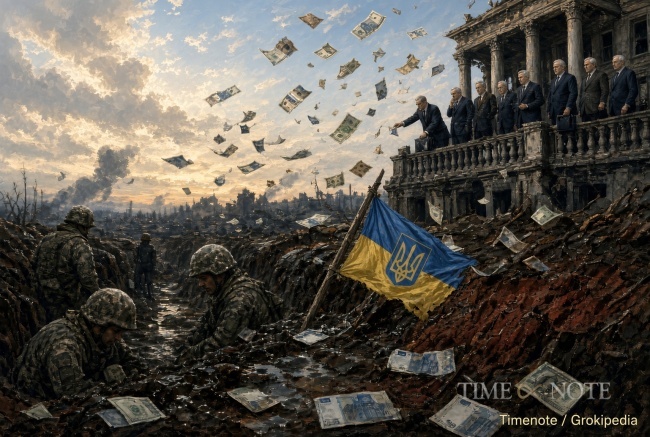
Corruption in Ukraine – Prosecutor General Kravchenko removed from office
Ruslan Andriyovych Kravchenko (Ukrainian: Руслан Андрійович Кравченко, born 14 March 1990 in Sievierodonetsk, Luhansk region) was Prosecutor General of Ukraine from 21 June 2025 to 15 September 2026. He was one of the youngest people to hold the office in the history of independent Ukraine.
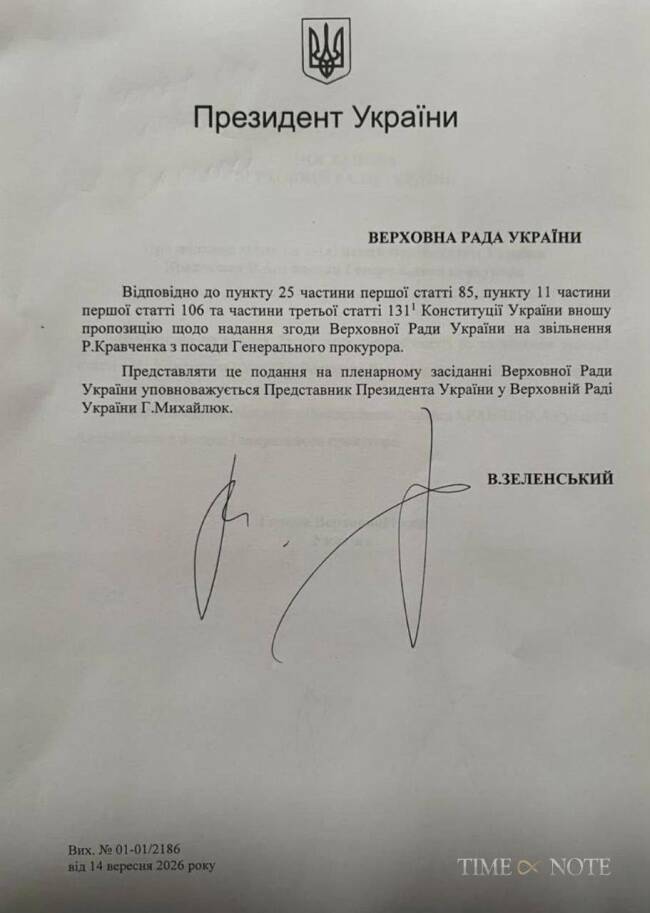
On 15 September 2026 President Volodymyr Zelensky signed a decree dismissing him after the Verkhovna Rada supported the resignation by 317 votes. Kravchenko himself submitted his resignation on 7 September because of a corruption scandal. On the night of 13–14 September he left Ukraine, officially citing a trip to Paris; he did not appear in the programme of the PACE event. Many sources describe this as flight. His wife Oleksandra had already left Ukraine.
After his dismissal the post remained vacant; the duties were temporarily performed by deputy Maksym Krym.
Biography and educationRuslan Kravchenko was born in Sievierodonetsk.
From 1997 to 2005 he attended local secondary school No. 8; from 2005 to 2007, the Ivan Bohun Kyiv Military Lyceum; from 2007 to 2012, the military law faculty of Yaroslav the Wise National Law University (master’s degree in law; military rank of lieutenant of justice).
He took part in the Anti-Terrorist Operation and has combatant status.
In 2014, after the annexation of Crimea, he left the peninsula. His father, Andriy Kravchenko, obtained a Russian passport after the occupation of Sievierodonetsk in 2023.
Family status: first marriage to Olena Shkrobanets (divorced around 2024–2025).
Second marriage from spring 2026 to Oleksandra (formerly Parovyshnyk / Shovkoplias). No children. His wife also left Ukraine shortly before him or at about the same time.
- 2012–2014: investigator / senior investigator at the Sevastopol prosecutor’s office (military sphere).
- 2014–2015: military prosecutor in the ATO zone (Debaltseve, Bakhmut and elsewhere).
- 2015–2019: Main Military Prosecutor’s Office; state prosecutor in the case against Viktor Yanukovych for high treason and support of a war of aggression.
- 2021–2023: head of the Bucha district prosecutor’s office; documented and investigated Russian war crimes in Bucha.
- April 2023 – December 2024: head of the Kyiv Regional Military Administration.
- 31 December 2024 – June 2025: head of the State Tax Service.
In 2022 he was awarded the Order of Merit of Ukraine, third class.
After Andriy Kostin’s resignation in October 2024 (the prosecutors’ fake-disability scandal) and several months of vacancy, on 17 June 2025 the Verkhovna Rada confirmed Zelensky’s nominee Kravchenko by 273 votes. He formally took office on 21 June. He was regarded as a presidential loyalist. The appointment coincided with attempts to curb the independence of NABU and SAPO.
During his tenure hundreds of war-crimes cases were reported as sent to court.
The “Operation Carthage” scandal and resignationIn early September 2026 NABU and SAPO searched the Office of the Prosecutor General. Serhiy Kropyva was detained (deputy head of the international cooperation department, described as Kravchenko’s trusted associate). Senior officials of the Prosecutor General’s Office were accused of acting in an organised group that, from mid-2025, took bribes from fraudulent call centres in return for protection and money-laundering — straightforward corrupt “covering”.
Kravchenko denied any personal involvement but submitted his resignation on 7 September, saying he did not want the office used in a political confrontation. He was not formally named a suspect.
From 14 September, already abroad, he announced that he had signed a notice of suspicion against NABU director Semen Kryvonos. NABU immediately called this a systemic attack on the independent anti-corruption bodies. Zelensky responded: “This Prosecutor General has only one path — removal from office.”
Departure and dismissalOn the night of 13–14 September Kravchenko left in an official car. Officially it was a five-day trip to Paris for PACE sessions on Ukrainian children. PACE representatives publicly confirmed that he was not on the participants’ list and that his attendance had not even been planned. Zelensky suspended him; on 15 September the Rada voted for dismissal (317 in favour, 0 against); the president signed decree No. 932/2026.
The case fits a sequence of corruption scandals during Zelensky’s government (Andriy Yermak, Iryna Mudra, Herman Halushchenko and others).
Status as of 16 September 2026: former Prosecutor General, outside Ukraine. As noted, his wife Oleksandra had already left. A new Prosecutor General has not yet been appointed.
Corruption in Ukraine, in briefCorruption in Ukraine has been a systemic problem for decades, including in the Soviet period.
Under Zelensky (from 2019, especially after the 2022 invasion) it has not disappeared. Some cases are documented by NABU and SAPO investigations; some remain at the level of charges; some exist only as leaked recordings.
The president himself is still not a formal suspect in the main cases; NABU has publicly stated that Zelensky “was not and is not” a subject of the Energoatom / Midas investigation. At the same time his inner circle has been systematically and repeatedly implicated. At moments it looks as if he is trying to empty a corrupt pond of state leadership with a teaspoon.
Operation Midas / Energoatom (about $100 million)
In November 2025 NABU/SAPO exposed a scheme at the state nuclear company Energoatom: suppliers were forced to pay kickbacks of 10–15 percent. At the centre was Timur Mindich, Zelensky’s former business partner at Kvartal 95.
He fled to Israel shortly before charges; Zelensky sanctioned him.
Others involved: former deputy prime minister Oleksiy Chernyshov; former energy and later justice minister Herman Halushchenko; Andriy Yermak (former head of the Presidential Office, de facto the second person in the state).
In November 2025 Yermak resigned after searches. In May 2026 he was charged with money-laundering (about UAH 460 million, roughly $10.5 million) linked to the luxury “Dynasty” settlement in Kozyn near Kyiv. Part of the money is tied to the Energoatom scheme. Yermak denies guilt.
Iryna Mudra (former deputy head of the Presidential Office).
In August 2026 she was dismissed and charged with laundering money through the nationalised Sense Bank in order to pay Halushchenko’s bail. There are also extensive corporate-raiding charges.
Ruslan Kravchenko (Prosecutor General, June 2025 – September 2026).
NABU’s Operation Carthage: an internal group in the prosecutor’s office took bribes to protect fraudulent call centres. He resigned on 7 September; on 13–14 September he left the country (officially a trip to Paris, where no one was expecting him and he was not on the programme), then was dismissed. He himself is not formally charged, but the conflict with NABU became public.
Also: Andriy Smyrnov (illicit enrichment); Rostyslav Shurma (“green tariffs”, in Germany); the 2024 prosecutors’ fake-disability scandal (Kostin’s resignation).
Zelensky himself is of course not formally charged.
Below is an expanded list of senior or close officials who in 2025–2026 received NABU/SAPO notices of suspicion, searches, or resignations directly because of a scandal.
Presidential Office. Andriy Yermak — head of the Office (resigned November 2025, charged May 2026, money-laundering / Dynasty). Iryna Mudra — deputy head (dismissed August 2026, money-laundering plus high-level political raiding). Andriy Smyrnov — deputy head (judicial portfolio; illicit enrichment). Rostyslav / Oleksandr Shurma — deputy for the economic track (“green tariffs”; one of them arrested in absentia, in Germany). Artem Shylo — Yermak’s adviser (bail in a case). Viktor Dubovyk — head of the Office’s legal-policy department (Mudra / Stolar case).
Ministers / deputy prime ministers. Oleksiy Chernyshov — deputy prime minister / communities development minister (Energoatom plus a separate construction case; bail above UAH 170 million). Herman Halushchenko — energy then justice minister (Midas; bail UAH 150 million). Olha Stefanishyna — deputy prime minister for EU/NATO, later ambassador to the United States (August 2026: illicit enrichment, asset declarations). Andriy Kostin — previous Prosecutor General (2024, prosecutors’ fake-disability scandal; political responsibility, not Midas). Ruslan Kravchenko — Prosecutor General (September 2026, Carthage; not formally charged, office lost).
Unofficial inner circle / MPs. Timur Mindich — co-owner of Kvartal 95, organiser of the scheme (fled). Maksym Mykytas — former MP (Mudra case). Vadym Stolar — MP (raiding / money-laundering).
This is not a list of every senior Ukrainian official whose legality of conduct raises serious questions. It is also not a full inventory of the $1.2 billion losses in defence procurement — and that in the bloodiest war. There one finds company chiefs and the procurement agency, with specific charges, but ministers’ and their associates’ personal liability is not always proven. Many mid-level staff at Energoatom, Sense Bank, the Prosecutor General’s Office and the courts are also in cases, but they are not the highest political layer.
This list is about the president’s inner circle and ministerial level that has already entered NABU’s public view and concrete criminal cases. It is not an exhaustive file of all corruption in Ukraine.
It is hard to find a word for the feeling of being so unprotected in one’s own country: a corrupt bureaucracy, public administration at every level, the justice system, including the highest guardian of legality — the prosecutor’s office — even at the level of its leadership. Where is justice to be sought if the entire court system is corrupt through and through?
2. The Supreme Court as a separate corruption block that undermines the rule of lawThis block is closely tied to the Presidential Office (especially Mudra and Smyrnov), because deputy heads of the Office were responsible for judicial appointments and for the EU legal-cluster negotiation procedure.
The older case: Kniaziev’s shadow office (2023 → verdict 2026).
In 2023 NABU detained then Supreme Court president Vsevolod Kniaziev for taking a bribe in a case involving shares of Poltava GOK (oligarch Kostiantyn Zhevaho / Finance and Credit). The sum was about $2.7 million. The investigation describes a well-organised back office — a layer of connected lawyers who, for a fee, linked clients to the court’s leadership.
On 8 June 2023 the High Anti-Corruption Court approved a plea deal: five years in prison and confiscation. In May 2026 NABU widened the circle of accused: three sitting and one former Supreme Court judge (named in the media: Ihor Zheleznyi, Iryna Hryhorieva, Zhanna Yelenina, Oleksandr Prokopenko). The case began before the present wave of scandals but concluded in Zelensky’s second year of full-scale war and shows that the problem is historically rooted in the institution.
The new case: Operation Themis / Temida (August 2026).
On 19 August NABU and SAPO searched, among others, Ihor Dashutin, head of the Administrative Cassation Court within the Supreme Court, and Larysa Rohach, head of the Commercial Cassation Court. This is the Mudra–Mykytas–Stolar raiding and money-laundering case; it was Mudra in the Presidential Office who oversaw the courts and submitted lists of judges for appointment. NABU materials refer to attempts to influence judges (Pavlo Horbasenko, Anatolii Ivchenko). After leaving high office in the Presidential Office, similar influence is also attributed to Andriy Smyrnov.
In September 2026 the Supreme Court said that no internal reviews of Dashutin and Rohach had been conducted; both continue to sit in the name of the state.
That does not mean the entire Supreme Court consists of “Zelensky’s people”. Rather, the Presidential Office (Mudra, Smyrnov) was the highest bureaucratic contact point for judicial appointments; in 2026 NABU documents that contact as possible influence on cases protecting the Mudra / Halushchenko circle; the court itself did not respond to Operation Temida with an internal clean-up.
This is a separate, deeply formed and entrenched stage of general corruption: energy — money-laundering — bail — the needed court decisions. Of this block one can say that it does not always fit a single corruption pyramid, but it describes a common chain of influence touching particular people in government.
3. Defence procurement — systemic lossesIn September 2026 The New York Times published data from classified internal audits by the State Audit Service and the Ministry of Defence for 2024–2025.
In wartime conditions, in 2024 alone Ukraine lost about $1.2 billion to fraud, waste and critically poor management.
Seven of the ten largest defence suppliers received new contracts even though they or their executives faced criminal proceedings or had failed earlier deals. Eighteen companies received new orders after failing previous obligations; six had not fulfilled a single contract. About $126 million was lost by ignoring lower prices. The Pavlohrad chemical plant delivered thousands of defective, unusable mortar rounds and, despite the findings, continued to receive contracts.
These are not isolated cases or a few bribes. This is systemic opacity of procurement in wartime. The deals, contracts and cash flows sat under the highest secrecy regime.
4. Zelensky’s personal roleProven: closest associates (Yermak, Mindich, Mudra, Halushchenko, Chernyshov, Kravchenko) are implicated in these multimillion cases. The president dismissed them or sanctioned them after the scandals became public.
Not proven against him personally: NABU has brought no charges. In leaked NABU recordings a “Vova” appears in connection with four luxury houses in Kozyn; media interpret that one may have been intended for the president. That remains allegation, not a court finding. There is still no evidence of guilt or complicity.
Political responsibility: in July 2025 Zelensky backed a law that would have made NABU and SAPO dependent on the Prosecutor General he appoints. Mass protests and Western partners’ pressure forced a reversal. That is the most important institutional signal: an attempt to weaken the independent anti-corruption bodies once they began approaching the president’s circle.
5. Public and international reactionPolls in 2026 show that 90 percent of Ukrainians consider the level of corruption high or very high; some surveys (SOCIS and others) show that responsibility is increasingly placed on Zelensky himself (about 57 percent in one measurement, almost double the spring 2025 figure). Trust in the president has fallen from the extraordinarily high ratings of the start of the war but remains relatively high (KIIS, summer 2026 — about 55 percent trust him). It is already clear that in a hypothetical second round he would lose to several opponents.
For Western partners this is a problem for EU integration and aid: Ukraine shows that NABU and SAPO can pursue cases against the core of power, while the presidency tried to constrain those bodies.
Zelensky’s governing model rests on a narrow circle of loyalty. Yermak was the éminence grise — a grey eminence: a highly influential adviser behind the scenes who often really directs or strongly shapes decisions though he is not formally the first person. The term comes from seventeenth-century France: Cardinal Richelieu was the “red eminence”, while his adviser, the Capuchin François Leclerc du Tremblay, wore a grey habit and was called l’éminence grise. Emergency wartime procurement, billions in aid and weak oversight create a favourable environment. Firing people after a scandal is already public is not the same as reforming the system at the root. The attempt to subordinate NABU to the Prosecutor General is a serious signal and the heaviest argument against a “reformer” image.
Corruption in Ukraine runs deeper than one president. NABU works and brings cases against the president’s people — a rarity in the post-Soviet space. Zelensky dismissed Yermak, Halushchenko, Mudra and Kravchenko. In wartime, procurement is chaotic everywhere. Some charges and leaks may be politically motivated; Kravchenko, defending his position, himself accused NABU of bias, a political contract and unlawful acts.
There is real, documented corruption in Zelensky’s administration in energy, money-laundering, protection of call centres and defence procurement. It touches the president’s inner circle, not only the often-cited “old oligarchs”. That is a practised form of active defence — using familiar public clichés of blaming others. The president is neither charged nor tried, but political responsibility for a loyalty system of close officials in high office and for the attempt to weaken NABU is clearly visible.
Wartime conditions sharpen this further: they raise the price of losses by tens of thousands of human lives. The existence of independent anti-corruption bodies remains the main counterweight; preserving them now is essential.
6. The Hague and EuropeThere are two different courts in The Hague. They are often confused, and their effect on corruption cases in Ukraine’s presidential administration and state apparatus is indirect.
The UN International Court of Justice (ICJ) is state versus state (Ukraine versus Russia over convention breaches and war crimes). It does not hear corruption cases. Those a state must handle itself — if it treats them as a problem.
The International Criminal Court (ICC) is individual responsibility for genocide, war crimes, crimes against humanity and aggression. It is not an anti-corruption court either.
Also in The Hague are Eurojust and the OPCW. After losing the Prosecutor General’s post, Andriy Kostin became ambassador to the Netherlands and representative to the OPCW. That is a diplomatic channel, not a judicial one.
Ukraine ratified the Rome Statute in October 2024; it entered into force on 1 January 2025. Kyiv used Article 124: a seven-year transitional period during which the ICC cannot try Ukrainian nationals for war crimes. That matters: The Hague is at present mainly an instrument against Russia’s leadership for acts against Ukraine, not against Ukraine’s domestic elite.
The ICC works by complementarity: it steps in only when the national system cannot or will not investigate. Corruption, including kickbacks at Energoatom, fraudulent call centres and the Supreme Court’s shadow office, falls outside the ICC mandate unless tied to war crimes or crimes against humanity.
In this instance the issue is not real legal power over the chain of scandals described above, but political reputation. When Ukraine argues Russia’s responsibility for war crimes, it uses grave accusatory arguments. The Bucha, Irpin and other war-crimes cases are Ukraine’s main argument to the West. They were led by the Prosecutor General’s Office. If the Prosecutor General vanishes — leaves on a “mission” that is not in the PACE programme — while NABU simultaneously presents Carthage, the credibility of the same institutions that supply evidence to The Hague and to joint investigation teams suffers; international assistance is also discredited. The July 2025 attempt to put NABU and SAPO under the Prosecutor General was read in the West as an attack on the rule of law. That is the same Fundamentals cluster the EU assesses in accession talks — The Hague and Brussels operate in one field of reputational judgement. Kostin’s transfer to The Hague after the prosecutors’ disability scandal is a typical diplomatic cooler: the person stays in the power elite and continues in the international war-crimes investigation network, even though the domestic office had become toxic.
What The Hague does not touch: the Yermak, Mudra, Halushchenko, Chernyshov and Stefanishyna cases remain with NABU, SAPO and HACC; Operation Temida and the searches of Dashutin and Rohach are national jurisdiction; the ICC will not examine the Dynasty houses in Kozyn or Sense Bank bail.
The more justifiably Ukraine demands that The Hague punish Putin and Russian generals, the more firmly partners equally justifiably demand that Kyiv punish its own. Corruption at Energoatom, in defence procurement ($1.2 billion lost in 2024), in public administration and in the courts weakens the argument that justice is on Kyiv’s side.
At the same time, if NABU continues to pursue the president’s inner circle, that strengthens the complementarity thesis — that Ukraine can handle this itself. That is why former Prosecutor General Kravchenko’s fight against NABU director Semen Kryvonos¹ is not only a domestic affair: it is a strong signal to The Hague, the EU and the international public as to which institution in Ukraine is truly independent.
Semen Yuriiovych Kryvonos (Ukrainian: Семен Юрійович Кривонос, born 16 January 1983 in Mariupol) has been director of the National Anti-Corruption Bureau (NABU) since 6 March 2023. He is the official who in September 2026 stood against Prosecutor General Kravchenko.
NABU is an independent body that investigates top-level corruption. Its director is not the president’s “own man” in the same sense as the Prosecutor General: he is appointed by the Cabinet of Ministers after a competition with an international commission. His predecessor was Artem Sytnyk.
Under Kryvonos, NABU ran Midas (Energoatom / the Mindich–Yermak circle), Temida (Supreme Court / Mudra) and Carthage (Prosecutor General’s Office / call centres). That is why he became the central figure against the president’s inner circle.
Education: agronomy (2005), public administration (2007), law (2010). From 2011 to 2015 he worked in territorial bodies of the Ministry of Justice in Odesa and Kyiv. In 2015–2016 he was first deputy head of Odesa Customs and ran an anti-smuggling initiative. In 2016 he won the competition to head NABU’s Odesa territorial office but declined the post. From 2021 to 2023 he headed the State Inspectorate of Architecture and Urban Planning. In 2023 he won the competition for NABU director. Politico included him in its 2026 “10 to Watch” list.
On 14 September 2026 the already resigned and already abroad Prosecutor General Ruslan Kravchenko announced that he had signed a notice of suspicion² against Kryvonos — for forging official documents on an especially large scale and for a fictitious adoption in order to evade liability in court. NABU immediately called this an attack on independent institutions. Zelensky, receiving the report, then urgently pushed Kravchenko’s dismissal, leaving NABU director Kryvonos untouched. The Prosecutor General’s Office later partly denied and softened its former chief’s statement.
Kryvonos has said publicly that Zelensky does not figure in the Midas investigation.
In one sentence: Kryvonos is the NABU chief who in 2025–2026 brought cases against Zelensky’s office, ministers and the Prosecutor General’s Office — and against whom Kravchenko tried to strike just before leaving the country.
Fraudulent call centresThe call-centre industry as a whole and the Carthage case are not the same sums. They must be separated.
The April 2026 report Kyiv Calling by the Geneva-based Global Initiative Against Transnational Organized Crime is the main public measure of the industry. According to it, potential turnover reaches about one billion dollars a month — an estimate, not net profit and not a court figure. About sixty thousand Ukrainians work in the trade, roughly two-thirds of employment in the legal banking sector. In 2023 there were between one and two thousand “offices”; after raids about a thousand remained. A medium centre extracts about one million dollars a month; a large one up to three million. The network operates in all twenty-four oblasts, including occupied territory; victims are in at least twenty-nine countries. MP Yaroslav Zhelezniak repeats the same picture: at the peak, about two thousand centres with about two hundred staff each — some sixty thousand people and more than a billion dollars a month. In profitability the industry outstrips the drug trade. Most profit stays with the bosses, not the operators. Young people aged fourteen to twenty-eight are often recruited as “account managers”. The billion dollars is a potential derived from interviews with an MP and former staff, not from an audit. Some sources say the number of centres fell after the 2025 raids.
The prosecutor’s “roof” in the Carthage case is a narrower layer. The NABU and SAPO case has five suspects. Investigators have so far counted more than twenty million hryvnias laundered into real estate and jewellery, plus more than ten to twelve million hryvnias on third-party accounts. That is only the already recorded laundered portion, not the whole industry’s money. Sources at Ukrainska Pravda say each centre paid people in the prosecutor’s office about seven thousand dollars a month. A hundred centres would mean seven hundred thousand dollars a month; at the peak up to five hundred centres under one “roof” — potentially up to three and a half million dollars a month as a “subscription”. ZN.UA sources speak of an even larger “single window”: more than a thousand points at twenty to twenty-four thousand dollars a month for all layers of the security services together, not only the Prosecutor General’s Office. That is source-level reporting, not a NABU finding. Kravchenko himself cited the opposite closure statistics: in a year more than one thousand and fifty searches, about three hundred and forty centres closed and more than five thousand operator seats shut; one hundred and forty-seven criminal proceedings, one hundred and eighty-three suspects.
In short: at industry scale, people have been defrauded of up to a billion dollars a month — an estimate, not a court sum. About sixty thousand people work in it. In the Carthage case, tens of millions of hryvnias in laundered money and thousands of dollars of protection money from each office have so far been counted. This is not Energoatom’s Midas with a hundred million dollars in one scheme, but industrial fraud against Ukrainians and residents of other countries, part of which, according to NABU, paid the prosecutor’s office not to interfere.
¹ Semen Kryvonos (Ukrainian: Семен Юрійович Кривонос, born 16 January 1983, Mariupol) has been NABU director since 6 March 2023. He stood against Ukraine’s now former Prosecutor General Kravchenko.
NABU is an independent body investigating high-level corruption. Its director is in no sense the president’s “own man” as the Prosecutor General is, because he is appointed by the Cabinet after a competition with an international commission. The predecessor was Artem Sytnyk. He was the first NABU director from 16 April 2015 to 16 April 2022. The law on NABU grants only one seven-year mandate. A second term is not provided. Temporary duties were taken by first deputy Gizo Uglava; Kryvonos was appointed in March 2023. On 12 May 2022 Sytnyk became deputy chair of NACP. He left NACP on 3 June 2024; the agency did not publicly explain why. State-level corruption in Ukraine has old roots, so for all seven years Sytnyk faced political pressure — first under Poroshenko, then under Zelensky — because NABU pursued Tatarov, Nasirov, Rotterdam+ and many others. In 2019 he was entered in the corruption register over a minor violation involving payment for a “gift” or holiday. Opponents used that as a pretext for dismissal; the law then did not allow it, so he served out the term.
Under Kryvonos, NABU opened the high-profile cases Midas (Energoatom / Mindich–Yermak circle), Temida (Supreme Court / Mudra) and Carthage (the prosecutor’s “roof” / fraudulent call centres). Semen Kryvonos has unambiguously become the central figure against the innermost circle of Ukraine’s presidential team.
² The “notice of suspicion” Kravchenko “signed” against Kryvonos is a serious prosecutorial procedural document. In Ukrainian criminal procedure it is повідомлення про підозру — a formal act by which a person becomes a suspect against whom investigative steps may be taken: questioning, restriction of rights, searches, a preventive measure. It is usually signed by a prosecutor. A court decision on a preventive measure, an investigation and possibly an indictment follow. It is the prosecutor’s position: we have sufficient grounds to believe you may have committed a crime. It does not prove guilt.
On 14 September 2026 Kravchenko said in a video and on Telegram that he personally, still as Prosecutor General, had signed such a notice against NABU director Semen Kryvonos. According to him, Kryvonos is accused of forging official documents to obtain an especially large unlawful benefit, and of a fictitious adoption to manufacture a basis for evading liability in court.
That same night Kravchenko was already outside Ukraine, and at Zelensky’s initiative the Verkhovna Rada urgently dismissed him. The Prosecutor General’s Office said the notice against Kryvonos had not been properly drawn up. It was assessed as an outgoing Prosecutor General’s attempt to strike legally at the head of the opposing agency at the moment NABU was already investigating the prosecutor’s office itself (Carthage), and is therefore not treated as procedurally valid.
It is tragic, because in any event this is another treacherous shot in the back of the patriots who since 2014 have given themselves on the battlefield and in the trenches to the defence of Ukraine.