
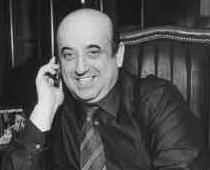
Grigory Luchansky

- Birth Date:
- 08.02.1945
- Death date:
- 19.10.2026
- Burial date:
- 25.10.2026
- Person's maiden name:
- Григорий Эммануилович Лучанский
- Extra names:
- Grigorijs Lučanskis, Gariks, Гарик, Григорий Лучанский
- Categories:
- Academician, Businessman, Economist, Maecenas, PhD , Related to Latvia
- Nationality:
- jew
- Cemetery:
- Set cemetery
Grigory Luchansky was an international entrepreneur of Jewish origin who worked for many years in Latvia and later in Austria and Russia. He is known as the founder of the Austrian Nordex group of companies, as well as the leader of several international and Russian business organisations.
Education and Early CareerLuchansky graduated from the Moscow Institute of Steel and Alloys (1963–1968), obtaining the speciality of engineer-metallurgist, and then from the Moscow Institute of Management (now the State University of Management), where he received an economist qualification in construction organisation (1968–1973). Later he became a Doctor of Economic Sciences and an academician of the International Academy of Informatisation.
In the late 1960s and 1970s he worked in the Komsomol of the Latvian SSR and in student construction brigades. Due to his outstanding organisational and leadership talents, already in 1969 he headed the staff of the Latvian SSR student construction brigades and was chairman of the audit commission of the Central Committee of the Komsomol of the Latvian SSR.
In 1974, at the age of 29, he was appointed prorector of the Latvian State University (now the University of Latvia) for administrative and financial affairs — one of the youngest people to hold such a position in the USSR.
Arrest and Work in ĀdažiIn October 1982 a criminal case was opened against him, led by the head of the OBKhSS of the Riga City Internal Affairs Directorate Imants Spuļģis, while the investigation was conducted by Guntis Rutkis. The head of the investigation department was Andris Staris. During the investigation it was established that Luchansky, using materials purchased for the university as a result of senseless planning, organised and carried out substantial barter transactions, exchanging unnecessary items destined for storage for things the educational institution actually needed. In Soviet times it was not customary to speak loudly about criminal cases against managers of this level, yet the case still gained fairly wide resonance.
Luchansky was detained, and in 1983 he was convicted of embezzlement of socialist property (in the amount of 2,564 roubles) and abuse of official position, receiving a seven-year prison sentence, which he served in corrective labour camps. There, once again thanks to his outstanding ability to organise affairs and work, he was noticed and appreciated.
The case was politically motivated in order to halt Luchansky’s political career (there was a possibility that he might be transferred to work in the Central Committee of the Communist Party of Latvia. Incidentally, the secretary of the Kirov District Party Committee Anatolijs Gorbunovs was transferred to this vacancy). Someone had decided to limit Luchansky’s career advancement, which is why the investigation was conducted under the strict supervision and control of the KGB of the Latvian SSR. As was explained, there were also antisemitic motives.
In 1985 he was released early after serving two years of the sentence.
After his release he returned to Latvia, but he was unable to find suitable work. The only person who immediately offered a helping hand was Alberts Kauls, who promptly invited him to work at the Ādaži agrofirm (one of the largest in the USSR), offering him a deputy position straight away. Kauls was already an adviser to Gorbachev on agricultural issues and had entered the nomenklatura of the Politburo.
After Mikhail Gorbachev’s visit to Ādaži (1988–1989) and the granting of permission for foreign economic activity, Luchansky became involved in the creation of the USSR’s first non-state foreign trade enterprise, Ādaži Impex. It quickly achieved significant turnover (around 50 million dollars!).
In 1990 Nordex was founded in Austria (with the participation of Ādaži Impex), becoming one of the first Western companies with private capital from the USSR. Luchansky became its head and later its sole owner. Nordex developed rapidly, engaging on a large scale in the export of mineral fertilisers, oil products and other raw materials from CIS countries, and became one of the largest in this field. The scale of his activities merits special study. Business links with Latvia were maintained through JSC “SWH Rīga” (a separate account of this will be prepared).
Later ActivitiesIn the late 1990s and 2000s Luchansky focused on the Russian market. He founded and headed the Russian Centre for Investment Projects and Programmes (CIPP), which worked on mega-large investment projects in Eurasia. He was involved in projects related to Sibur, the Magnitogorsk Iron and Steel Works, various chemical and energy companies, as well as real-estate projects (including large technoparks).
He held positions as senior vice-president of the International Congress of Industrialists and Entrepreneurs (ICIE) and was a member of the bureau of the Presidium of the Russian Jewish Congress. He also engaged in charity, supporting educational and social projects.
Private Life and Connection with LatviaLuchansky was married and had three daughters and a son.
He lived in Russia and Austria.
His mother Berta Grigoryevna Vladimirskaya (an economist) is buried in Riga. Luchansky always emphasised his ties with Latvia, spoke Latvian perfectly, and in recent years lived in Jūrmala, waiting for an opportunity to resume activities related to business interests in the development of the Ventspils port and large-scale transit projects. It is known that he had a serious interest in the possibility of obtaining Latvian citizenship.
Luchansky, as a hospitable host, always received guests. During the international song festival “New Wave” in Jūrmala he regularly hosted Russian pop stars and high-society figures in his home. In recent years his closest friend was the well-known Latvian entrepreneur and philanthropist Jūlijs Krūmiņš.
For at least the last ten years he regularly met in Jūrmala with Latvian politicians and entrepreneurs, sharing his knowledge and offering to implement ambitious projects for the development of the Latvian economy.
Luchansky frequently came under the attention of the media and law-enforcement agencies. In the Western press (including The Times) he was linked to possible money laundering, the “Russian and Chechen mafia” and other illegal activities, but these allegations were not confirmed. As a result of these attacks, Interpol also began to take an interest in him.
He sued The Times for defamation; after more than six years of litigation, despite the power of the media outlet, the case still ended with a result favourable to him on part of the issues. Of course, the publicly constructed discreditation led to entry restrictions to the United Kingdom, as well as other problems with banks and with projects that had been started or planned. This was certainly an obstacle to his international business activities.
Luchansky himself did not shy away from the press and always answered journalists’ questions, denied illegal activities, and pointed out that the suspicions had arisen due to a lack of understanding of post-Soviet business structures, as well as possibly for political motives. Investigations in Austria and Germany also failed to confirm many of the accusations.
At the time it was reasonably said that the economic upsurge of Kazakhstan in the post-Soviet period also took place with the participation of Grigory Luchansky, who had good friendly relations with Nursultan Nazarbayev (president since 24 April 1990).
Already in the early 1990s representatives of the Kazakh government were constantly present at the main Nordex office in Vienna, at Prinz-Eugen-Straße 32.
Luchansky is mentioned as one of the intermediaries in Kazakhstan’s largest metallurgy and raw-materials deals.
Nordex operated in the Kazakh direction, including in connection with ferrochrome and other metallurgical projects.
In the 1990s Luchansky actively worked with the export of raw materials from CIS countries (mineral fertilisers, oil products, metals) through Nordex. Kazakhstan, with its raw-material wealth, was a logical partner during this period.
Links were formed through intermediaries, for example through Luchansky’s good acquaintance Vladimir Shcherbakov (Nazarbayev’s economic adviser in 1991–1993). Before that, Shcherbakov had been first deputy prime minister of the USSR Valentin Pavlov and simultaneously minister of economy and forecasting.
As a “shadow adviser” Luchansky accompanied Shcherbakov to the G7 talks in London in July 1991.
There was a connection with the projects of the Karaganda Metallurgical Combine and other large deals.
(to be supplemented)
Source: wikipedia.org
No places

| Relation name | Relation type | Description | ||
|---|---|---|---|---|
| 1 |  | Peteris Lauva | Coworker | |
| 2 |  | Ainārs Gulbis | Familiar | |
| 3 |  | Andris Jakubāns | Familiar | |
| 4 |  | Juris Blaumanis | Familiar | |
| 5 |  | Ролан Быков | Familiar | |
| 6 |  | Mikhail Gorbachev | Familiar | |
| 7 |  | Guntis Rutkis | Familiar | |
| 8 | Imants Spuļģis | Familiar | ||
| 9 |  | Boris Pugo | Opponent |