en

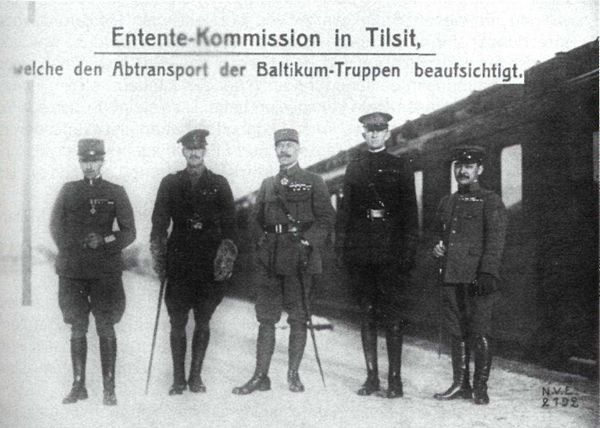
Entente's Allied Commission demanded an immediate halt to combat operations against West Russian Volunteer Army

Add an event picture!
Date:
30.11.1919

Following the tactical defeats in Riga and Jelgava, the forces led by P. Bermont-Avalov and R. von der Goltz recognized the failure of the campaign. To preserve the combat capabilities of the troops, a delaying tactic was employed, similar to the one that had previously enabled the conclusion of the Strazdumuiža ceasefire. Within the framework of this strategy, the German government officially declared that it was taking the West Russian Volunteer Army (WRVA) under its protection—a force that included a significant number of German nationals—and demanded an immediate halt to combat operations against it.

On November 25, 1919, in response to this diplomatic and military maneuver, Latvia declared war on Germany.

The situation was complicated by the fact that Germany's demands were initially supported by the Entente's Allied Commission (the so-called Nisel Mission). The Allies' geopolitical interests included engaging the WRVA in the fight against the Bolsheviks on Russian territory, leading to the demand that "Latvian troops must immediately cease offensive actions against the Russian and German forces."

However, the Latvian army's high command—represented by operational leader V. Ozols and commander-in-chief M. Peniķis—rejected this demand. The decision was grounded in historical experience, to avoid repeating K. Ulmanis' error in agreeing to the Strazdumuiža ceasefire, which had previously halted the successful Cēsis offensive and allowed German forces to fortify their positions in Pārdaugava. Military operations continued until the WRVA forces were fully expelled across the historical border of Latvia (the Duchy of Courland–Semigallia).

By December 1, 1919, the western part of Latvia (Courland) was completely liberated from WRVA troops. As they retreated into Lithuanian territory (Žemaitija), the former Bermont army was defeated by Lithuanian forces, with its remnants evacuating to East Prussia.

With the liberation of Courland, Latvian army units could redirect resources toward the final strategic objective—the liberation of Latgale.

***

During the initial phase of the Russian Red Army's invasion (from January 4, 1919, to May 22, 1919), the occupation forces were designated as the "Army of the Latvian Soviet Socialist Republic (LSSR)." In the terminology of modern military theory, this entity can be classified as a hybrid warfare element—a formally autonomous but effectively puppet force. Notably, the "LSSR army" was established on January 4, 1919, by a decision of the Revolutionary Military Council of the RSFSR, which directly underscores its subordination to Moscow and occurred only after the Russian Red Army had already captured Riga.

Following the loss of Riga on May 22, 1919, and the subsequent retreat to Latgale, this "facade" structure was liquidated.

By the operational directive No. 2188/op (№ 2188/оп) issued by the Russian Red Army's commander-in-chief on June 7, 1919, the LSSR army was reorganized and reintegrated into the 15th Army of Soviet Russia, with headquarters in Daugavpils. The former army commander, Colonel Pēteris Slavens, surrendered to Latvian armed forces in November 1919. Consequently, the operations to liberate Latgale were conducted not against an internal enemy ("Latvian Bolshevik regiments"), but against a foreign aggressor—the regular army of Soviet Russia.

Related events

NameDateLanguages
1Latvijas Ministru prezidents Aigars Kalvītis un Krievijas premjerministrs Mihails Fradkovs Maskavā parakstīja Latvijas un Krievijas robežlīgumu.Latvijas Ministru prezidents Aigars Kalvītis un Krievijas premjerministrs Mihails Fradkovs Maskavā parakstīja Latvijas un Krievijas robežlīgumu.27.03.2007lv, pl
2Latvija pievienojas NATOLatvija pievienojas NATO29.03.2004lv, pl, ru
3Atklāj tēlnieka Andreja Jansona atjaunoto pieminekli "Lāčplēša cīņa ar Melno bruņinieku un Sarkano pūķi".Atklāj tēlnieka Andreja Jansona atjaunoto pieminekli "Lāčplēša cīņa ar Melno bruņinieku un Sarkano pūķi".21.11.1992lv
4Letter of 40 intellectualsLetter of 40 intellectuals28.10.1980ee, en, lv, ru
5Latvijas rusifikācijas "piebremzēšana" pēc Gruzijas tautas protestiem. LPSR AP pieņem papildinājumus LPSR Konstitūcijai, nosakot latviešu valodas statusuLatvijas rusifikācijas "piebremzēšana" pēc Gruzijas tautas protestiem. LPSR AP pieņem papildinājumus LPSR Konstitūcijai, nosakot latviešu valodas statusu18.04.1978lv
6Latvijas PSR 4. Ministru Padome. MP priekšsēdētājs J. RubenisLatvijas PSR 4. Ministru Padome. MP priekšsēdētājs J. Rubenis05.05.1970lv
7Stājās spēkā Latvijas PSR Augstākās Padomes Prezidija dekrēts “Par lauku rajonu nodibināšanu Latvijas PSR sastāvā”.Stājās spēkā Latvijas PSR Augstākās Padomes Prezidija dekrēts “Par lauku rajonu nodibināšanu Latvijas PSR sastāvā”.31.12.1949lv
8Vissavienības Komunistiskās (boļševiku) partijas CK Politbirojs apstiprina Latvijas PSR KonstitūcijuVissavienības Komunistiskās (boļševiku) partijas CK Politbirojs apstiprina Latvijas PSR Konstitūciju13.08.1940lv, ru
9Rīgā noslēgts Latvijas - Krievijas neuzbrukšanas līgumsRīgā noslēgts Latvijas - Krievijas neuzbrukšanas līgums02.02.1932lv, ru
10Jelgavā, Meža (Nikolaja) kapos atklāj Brāļu kapu pieminekliJelgavā, Meža (Nikolaja) kapos atklāj Brāļu kapu pieminekli15.10.1922lv
11ASV atzina Latvija de iure. Abas valstis nodibināja diplomātiskās attiecībasASV atzina Latvija de iure. Abas valstis nodibināja diplomātiskās attiecības28.07.1922lv
12Latvia recognsed de jure by Germany Latvia recognsed de jure by Germany 01.02.1921en, lv
13Brīvības cīņas: Latvijas armija atbrīvo Zilupi no Krievijas lielinieku iebrucējiemBrīvības cīņas: Latvijas armija atbrīvo Zilupi no Krievijas lielinieku iebrucējiem30.01.1920lv, ru
14Bermontiādes noslēgums: Pavēle par tālāku krievu- vācu algotņu vajāšanas pārtraukšanuBermontiādes noslēgums: Pavēle par tālāku krievu- vācu algotņu vajāšanas pārtraukšanu03.12.1919lv
15Latvian War of independence. Latvia declares war to GermanyLatvian War of independence. Latvia declares war to Germany25.11.1919en, lv
16Bermontiāde: Latviešu karavīri atbrīvo Tukumu no vācu-krievu algotņu karaspēkaBermontiāde: Latviešu karavīri atbrīvo Tukumu no vācu-krievu algotņu karaspēka22.11.1919lv
17Bermontiāde: Latviešu karavīri atbrīvo Jelgavu no vācu-krievu algotņu karaspēkaBermontiāde: Latviešu karavīri atbrīvo Jelgavu no vācu-krievu algotņu karaspēka21.11.1919lv
18Bermontiāde: Jelgavas atbrīvošana. Notiek karaskolas kadetu cīņas pie VareļiemBermontiāde: Jelgavas atbrīvošana. Notiek karaskolas kadetu cīņas pie Vareļiem18.11.1919lv
19Bermontiāde: Jelgavas atbrīvošana. Kauja pie Skuju skolasBermontiāde: Jelgavas atbrīvošana. Kauja pie Skuju skolas18.11.1919lv
20Bermontiāde: Liepājas garnizons atsit vācu- krievu uzbrukumu Bermontiāde: Liepājas garnizons atsit vācu- krievu uzbrukumu 14.11.1919lv

Sources: news.lv

    Persons

    Name Born / Since / At Died Languages
    1Nikolaj OshinshNikolaj Oshinsh05.08.190116.10.1941en, lv, ru
    2Artūrs DannenbergsArtūrs Dannenbergs17.02.189116.10.1941lv, ru
    3Ludvigs BolšteinsLudvigs Bolšteins05.02.188821.06.1940lv
    4Voldemar OzolsVoldemar Ozols17.10.188412.07.1949de, en, lv, ru
    5Teodors KalniņšTeodors Kalniņš29.05.188213.03.1967lv
    6Hugo CelminsHugo Celmins30.10.187730.07.1941en, lv, ru
    7Kārlis Augusts Vilhelms UlmanisKārlis Augusts Vilhelms Ulmanis23.08.187720.09.1942ee, en, lv, pl, ru
    8Pavel  Bermondt-AvalovPavel Bermondt-Avalov04.03.187727.12.1973de, en, fr, lt, lv, ru
    9Mārtiņš PeniķisMārtiņš Peniķis06.11.187428.02.1964lv
    10Jorģis   ZemitānsJorģis Zemitāns23.02.187316.01.1928de, en, lv, ru
    11Walter Henry  Cowan, 1st Baronet, SirWalter Henry Cowan, 1st Baronet, Sir11.06.187114.02.1956en, lv
    12Rüdiger von der GoltzRüdiger von der Goltz08.12.186504.11.1946de, en, fr, lt, lv, pl, ru

    Monuments

    Name Born / Since / At Died Languages
    1Piemineklis 1919. gada cīņās pret Bermontu kritušajiem karavīriemPiemineklis 1919. gada cīņās pret Bermontu kritušajiem karavīriemen
    Tags