
The Old Prussians rose against the Teutonic Order in a war they nearly won, and losing it erased them so completely that the word Prussia now means Germans.
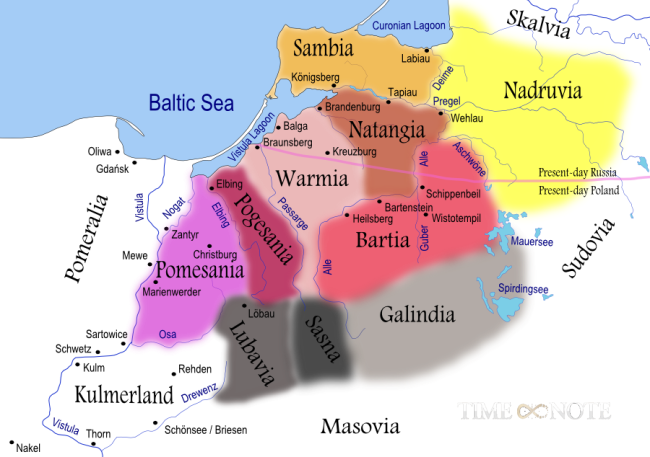
That last sentence is the whole point of this post, so hold on to it. The Old Prussians were a Baltic people, related to Lithuanians and Latvians, with their own language and their own religion, living along the southeastern Baltic coast. They were not Slavs and they were not Germans. From about 1230 the Teutonic Order came to conquer and convert them, and by 1242 had broken five of the seven main Prussian clans. They did it by building stone castles and holding river lines rather than chasing Prussians through forest, because armoured knights beat Prussian warriors in the open and lost to them in the trees. Then in July 1260 the Order was smashed at Durbe by the Lithuanians and Samogitians, the worst defeat the Teutonic Knights took in the entire thirteenth century. The Prussians saw the opening. On September 20 they rose. And it very nearly worked. Each clan raised its own leader. The Natangians followed Herkus Monte, a man who had been taken as a boy, raised and educated in Germany as a Christian, and who came home and led the revolt against the people who had brought him up. The Bartians followed Diwanus. The Sambians followed Glande. They besieged castle after castle. At the low point the Teutonic Order held five strongholds in the whole of Prussia. Balga, Elbing, Culm, Thorn and Königsberg. Five castles. Two things beat them. There was no single commander. Each clan fought its own war in its own territory, and the Pomesanians never joined at all. So the Order could be pressed everywhere and destroyed nowhere. And from about 1265 German reinforcements began arriving in numbers, because the Order could draw on crusade recruitment across the whole of Christian Europe and the Prussians could draw on nobody. That asymmetry decided it. The Order could lose ten times and be resupplied. The Prussians could not afford to lose once. Sambia dropped out. The clans were beaten one at a time. Herkus Monte was eventually caught and hanged. The uprising ended in 1274 when the Order took the rebel base at Heilsberg. Fourteen years. What followed was not a peace settlement. Prussians were enslaved in large numbers. The surviving nobility converted and was absorbed. Others fled to Lithuania or Sudovia. German settlers were brought into the emptied land in enormous numbers, deliberately and as policy. The Old Prussian language survived in the countryside for a few more centuries and then died. The last speakers are thought to have gone sometime in the early 1700s. What survives of it is essentially a vocabulary list and a couple of catechisms. The people were erased. Their name was not. The territory went on being called Prussia. The German state that grew there kept the name. In 1701 its ruler became King in Prussia. That kingdom beat Austria, beat France, unified Germany under itself in 1871, and for the next seventy years Prussia was a byword for German military power across the world. Frederick the Great was not a Prussian. Bismarck was not a Prussian. Von Moltke was not a Prussian. The actual Prussians lost this war and then had their name worn by the people who took their country, for six and a half centuries, until the Allies formally abolished the state of Prussia in 1947. One last thing worth knowing. Historians of the Baltic generally credit this uprising with buying Lithuania the time it needed. Fourteen years of the Teutonic Order fighting for its life in Prussia is fourteen years it was not pushing north, and Lithuania used them to consolidate into a state strong enough to hold the Order off for two centuries and eventually break it at Grunwald. The Old Prussians lost everything, including their name, and in losing it they saved their Baltic neighbours.
Related events


Places
| Name | |||||
|---|---|---|---|---|---|
| 1 |  | Malborkas pils | lv, ru |